Mike Caemmerer on learning business through his teaching experiences
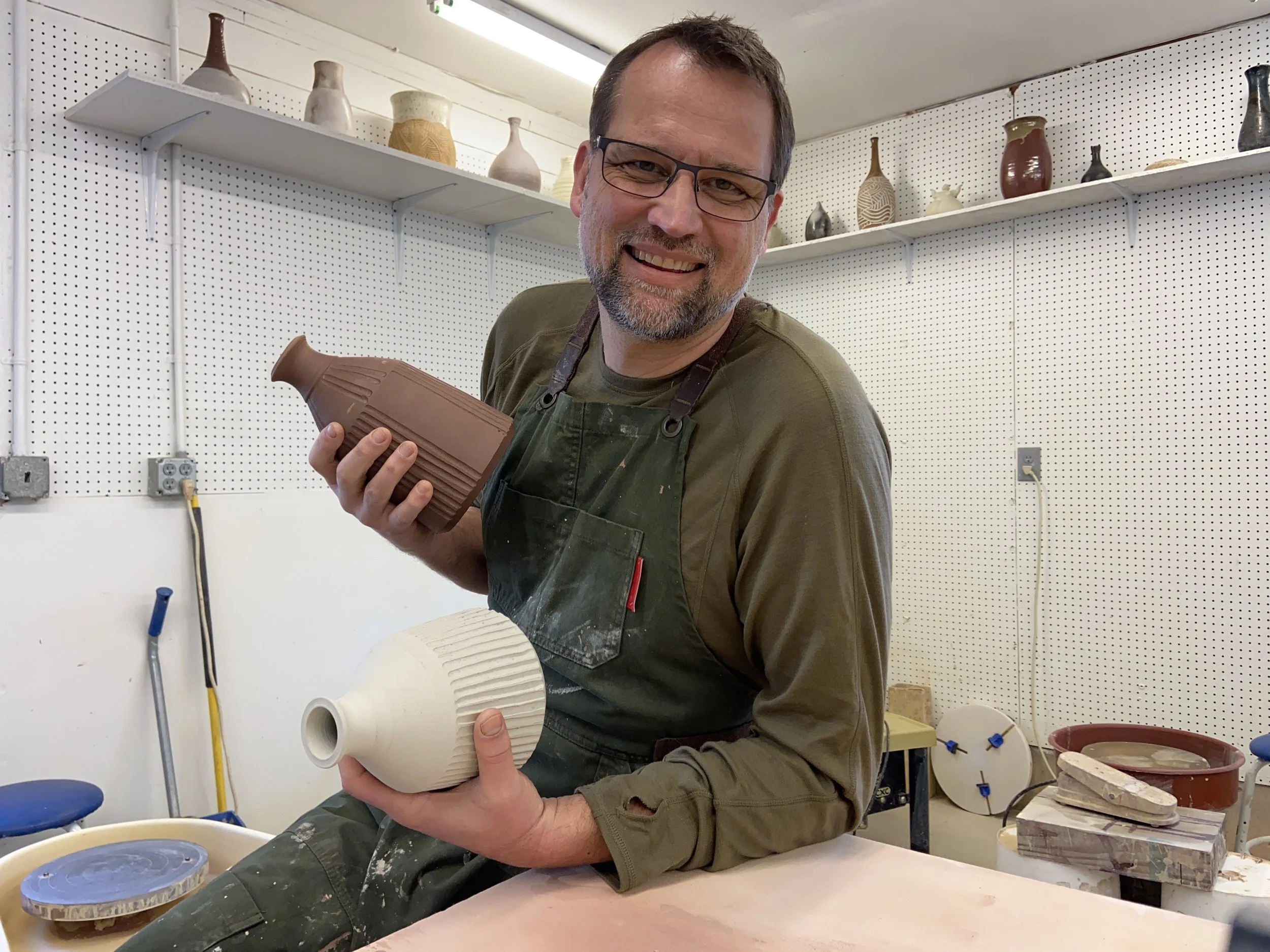
Photo Credit: Mike Caemmerer
Mike Caemmerer, owner of Tall Tree Ceramics in Plain, WA, has lived and worked all over the world teaching, coaching, directing theatre productions, and working at arts organizations. To say he knows his stuff is an understatement! Mike is someone who plans carefully but embraces the unpredictability that comes with being a creative; he has business savvy but values his artistic desires. Ultimately, he leaves space for “yes, and.”
How did you start your creative journey and what made you decide to do it full time?
So, my dad was a university art professor, the Chair of the Art Department at Valparaiso University, and my mom was a weaver. I kind of didn’t have a choice in the matter, I was born to be a creative, so I never shied away from that. I loved public speaking, I loved acting as a kid. From a very early age, I was into the creative side of life and taking part in all those opportunities just naturally, not because I was pushed into them or anything, just wanting to. And, because of that, I never felt the need to study it. I just did it. It didn’t mean that I felt like I knew everything about it, I just knew enough to do the things I wanted to do.
My art is teaching. And that's what I'm best at. I think my creative approaches to teaching are ways that give people access to the arts that they wouldn't have had before. So whether it was high school or middle school students overseas or whether it's ceramic students now, I think there's a real art to being able to engage students in a way that makes them own what their processes are. And gives them the confidence to then go out and do that themselves. That's what was given to me by my family, by my parents. And so, the creative side of it, I didn't have a choice. My choice was what art I wanted to choose.
Photo Credit: Mike Caemmerer
I’m curious how you learned the money side of your business, what was the process for that?
That’s a great question. Artists are notoriously bad with money, and teachers are notoriously bad with money. So art teachers are really bad with money! When an art teacher goes to an administrator and asks for $1,000 to buy this new thing, the administrator asks for that expense to be rationalized, and regardless, it’s often a no. Unfortunately, art teachers have gotten so used to being turned down, that they don’t even ask anymore. But, for me, as a teacher in India when I was working at the American Embassy School and I wanted to do these significant productions, I started learning the whole budgetary process of rationalizing your costs versus the revenue that you’re going to generate so that, at the very least, we aren’t losing money to start with. If I could show at the end of a year doing three productions, the school would generate $10,000 of revenue, then the school would say “you can do as many productions as you want,” right? That got me into this mode of being able to understand the relationship between cost and benefit.
So, when I started this business in 2020, I had to figure out what my five year plan was. How much money did I need to generate? I started with a $30,000 cost to build my studio and $4,000 to buy my kiln. I scrounged and refurbished two ceramic wheels that are great, and I ended up only paying $200 for both of them, which is ridiculous because they’re worth at least $1,000 each now. So, I found ways of cutting costs, but my initial set up was $36,000 by the time everything was purchased. And, then, I also have to pay for my ceramics equipment, supplies, and tools and I had to buy all the stuff to go sell at the market with a tent and tables. So, I did the business plan for it and laid things out pretty clearly for myself. And, that meant I had a yearly target for how much revenue I had to generate.
Is there anything that has surprised you or that you didn’t anticipate?
I think the most surprising thing is that I can’t anticipate anything! I can’t anticipate that I’m going to sell a particular thing. Last summer, I sold $100 bowls left, right and center. They were just flying off the shelves. This summer, I’m not selling any. I have almost all the same ones that I started the summer with. Whereas everything else, the vases, the cups, everything else is gone. So, I think trying to keep things fresh.
The thing to take out of it is I should make what I want to make and let people take that for what it is. I put the things out there that are important to me to put out there. And, if in the end, I don’t get to do this business anymore because those don’t move, then I’m not meant to do this business anymore, I’ll go find something else to do. It’s just kind of the way it has to be, because nobody wants a bunch of garbage sitting on a table. So, I just breathe and remember why I’m sitting in the studio. What I’m trying to do is to be creative as much as I can be to meet my own needs. And, as soon as it stops being fun, I just have to stop doing it.
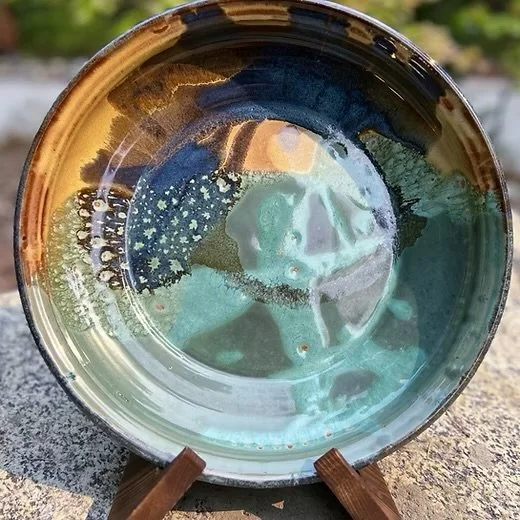
Photo Credit: Mike Caemmerer
Have you had a tough lesson learned that you’d be willing to tell me about? And, if anything has changed in how you approach things now as a result of that?
I don’t know that I can point to one specific example, but without question, I have been doing some self-evaluation because I have a fairly significant level of arrogance to myself. And, I know that I can do things that other people can’t do; I know that I approach things in ways that other people don’t understand. That attitude has gotten me into trouble on plenty of occasions, and what I have learned over time is that you actually do have to go through all the hoops.
My issue is always thinking that I’m the one that has the answer to how to do “that.” And, it’s bad for me because it’s not only a bad for relationship kind of thing, but I don’t learn anything that way, right? One day, my director in Delhi and I were in a meeting and there had been some disagreements in a staff meeting. He came to talk to me about it and he wanted my take on an idea he pitched to me. I said, “yeah, but…” and he stopped me before I could say anything else. He goes, “not yes, but… yes, and.” Which is, you know, that’s my business! I’m a theater guy and I should know that you respond to people with “yes and.” That’s the way to respond in all situations, not just in theater. When you’re working, if you just add the word “and” on to something, it opens up all the possibilities. And, I knew that because I teach it. But, when I was in other scenarios, I wasn’t applying that. I don’t need to have that attitude about it.
So, there aren’t many specific instances. I think it happens regularly to me and I realize that I need a perspective shift a little bit so that I have avenues stay open to me.